
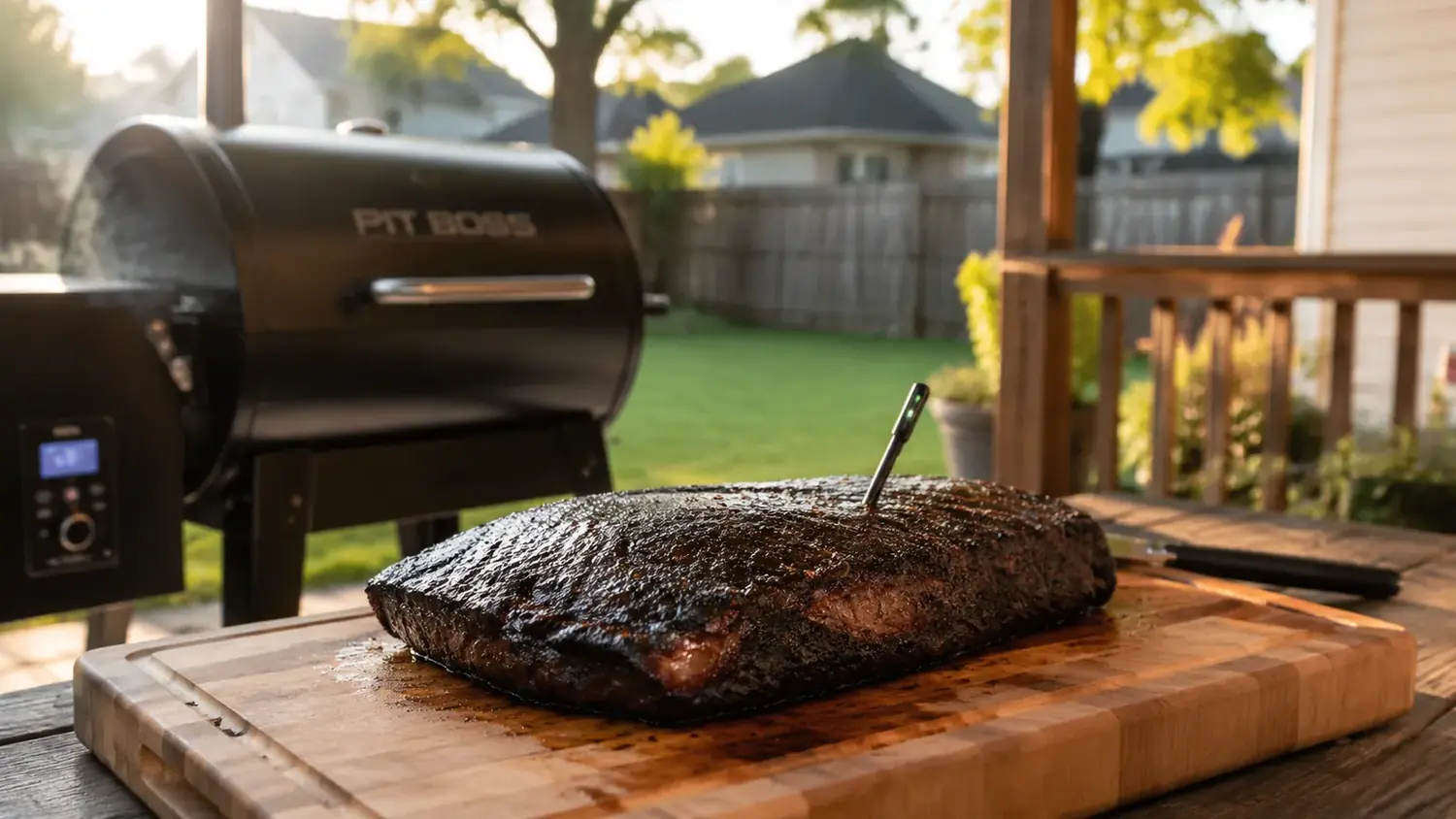
I bought the MEATER Plus last Memorial Day weekend, mostly because my wife Diane was tired of watching me open the lid on the Pit Boss every four minutes to poke at a brisket with an instant-read thermometer. I've been grilling for over thirty years here in Kansas City, and I'll admit I was skeptical of anything that needed an app to tell me when my meat was done. A full grilling season later, from that first batch of burgers through a Thanksgiving turkey with my grandson Eli helping me carve, I've got a real answer on whether this wireless probe earns its spot in the drawer next to my old dial thermometers, or whether it's just another gadget that sounded better in the ad than it worked in the yard.
This isn't a two-week impression. I've run this thing through steaks, whole chickens, pork butts, a Thanksgiving turkey, and more racks of ribs than I can count, on both my Pit Boss pellet grill and my 22-inch Weber kettle. Diane uses it now too, which tells you something, because she's not one to fuss with a gadget that doesn't earn its keep.
The Quick Verdict
A genuinely useful wireless probe that nailed doneness on steaks and low-and-slow smokes all season, though the Bluetooth range is shorter than advertised and the ambient sensor needs a real learning curve near hot coals.
Amazon Check Today's Price →Tired of playing the lid-opening guessing game every ten minutes?
The MEATER Plus lets you walk away from the grill and still know exactly when your meat hits temp, right from your phone. Here's the current listing so you can check today's price and availability.
Amazon Check Today's Price on Amazon →How I've Used It
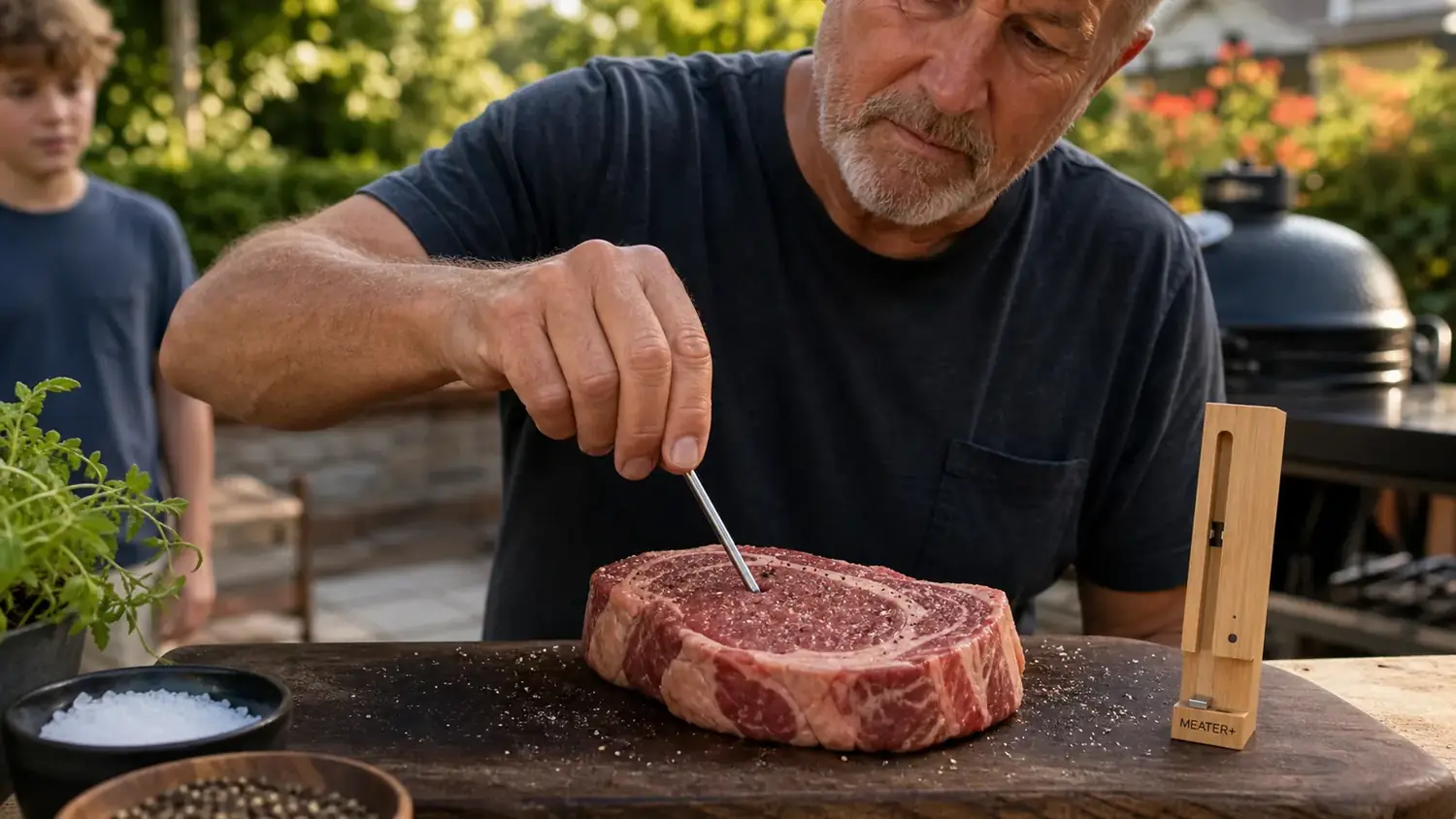
The MEATER Plus is a wireless probe with no wires at all, which was the first thing that had me skeptical. You insert it into the meat, the probe talks to a little charging block that doubles as a Bluetooth booster, and the booster talks to an app on your phone. I set it up that first Memorial Day weekend on a batch of burgers, more to test whether the thing even worked than because burgers really need a wireless thermometer. It read the internal temp accurately within a couple degrees of my old instant-read, and I was cautiously optimistic.
Where it actually proved itself was on a pork butt I smoked on the Pit Boss the following weekend, an eight-hour cook where I would normally be out on the patio checking the meat every hour with a flashlight. Instead I set the target temp in the app, went inside to watch a Royals game with Diane, and got a notification on my phone when it hit 203 degrees. That's the moment I stopped thinking of this as a gadget and started thinking of it as a tool I'd actually keep using.
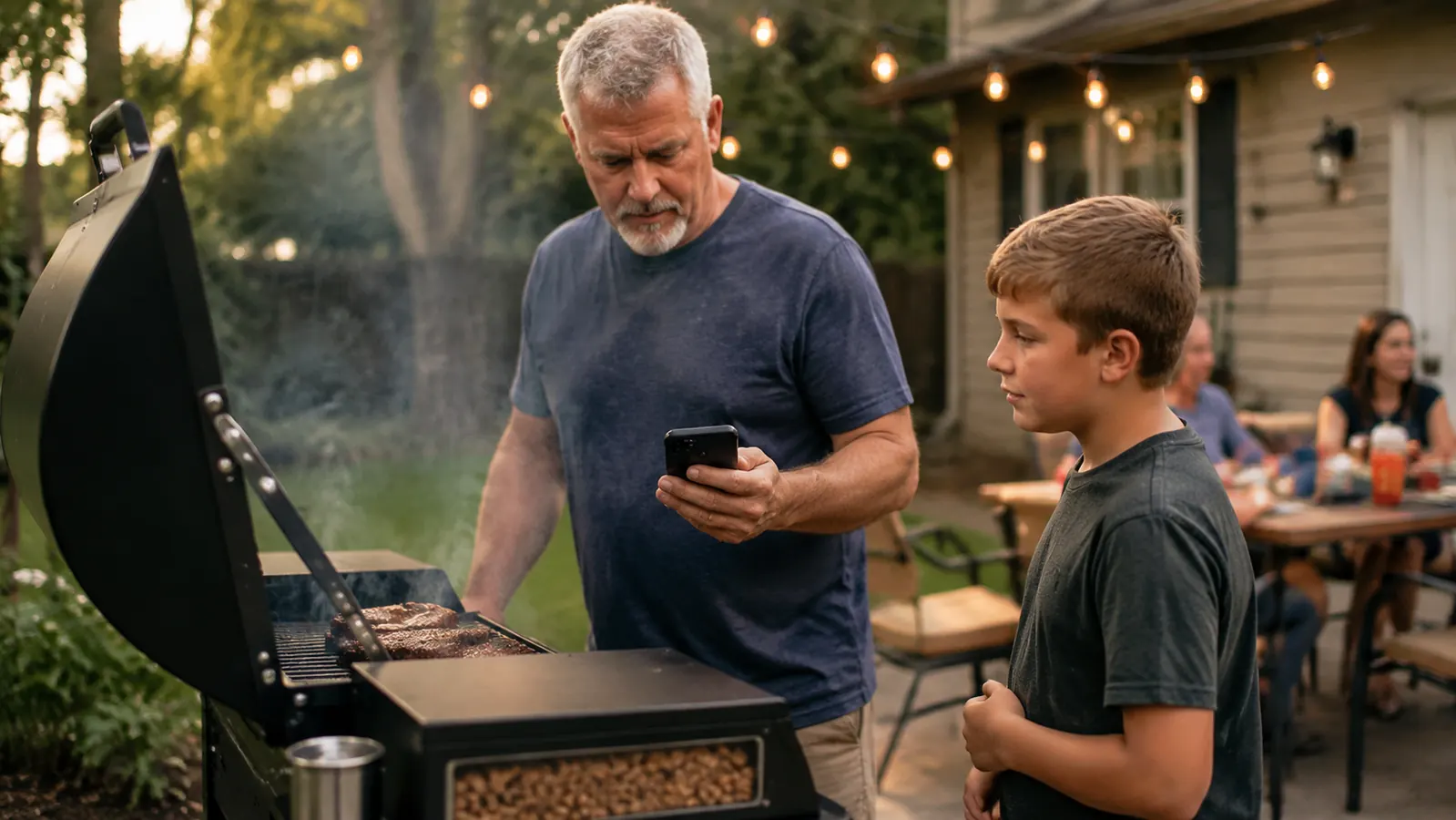
Since then I've used it on probably forty cooks over the season, steaks and chicken thighs on the Weber kettle, ribs and a couple of pork shoulders on the Pit Boss, and that Thanksgiving turkey where Eli stood next to me checking the app on my phone like it was a video game. He's twelve and more comfortable with the app than I am half the time, which is its own kind of endorsement.
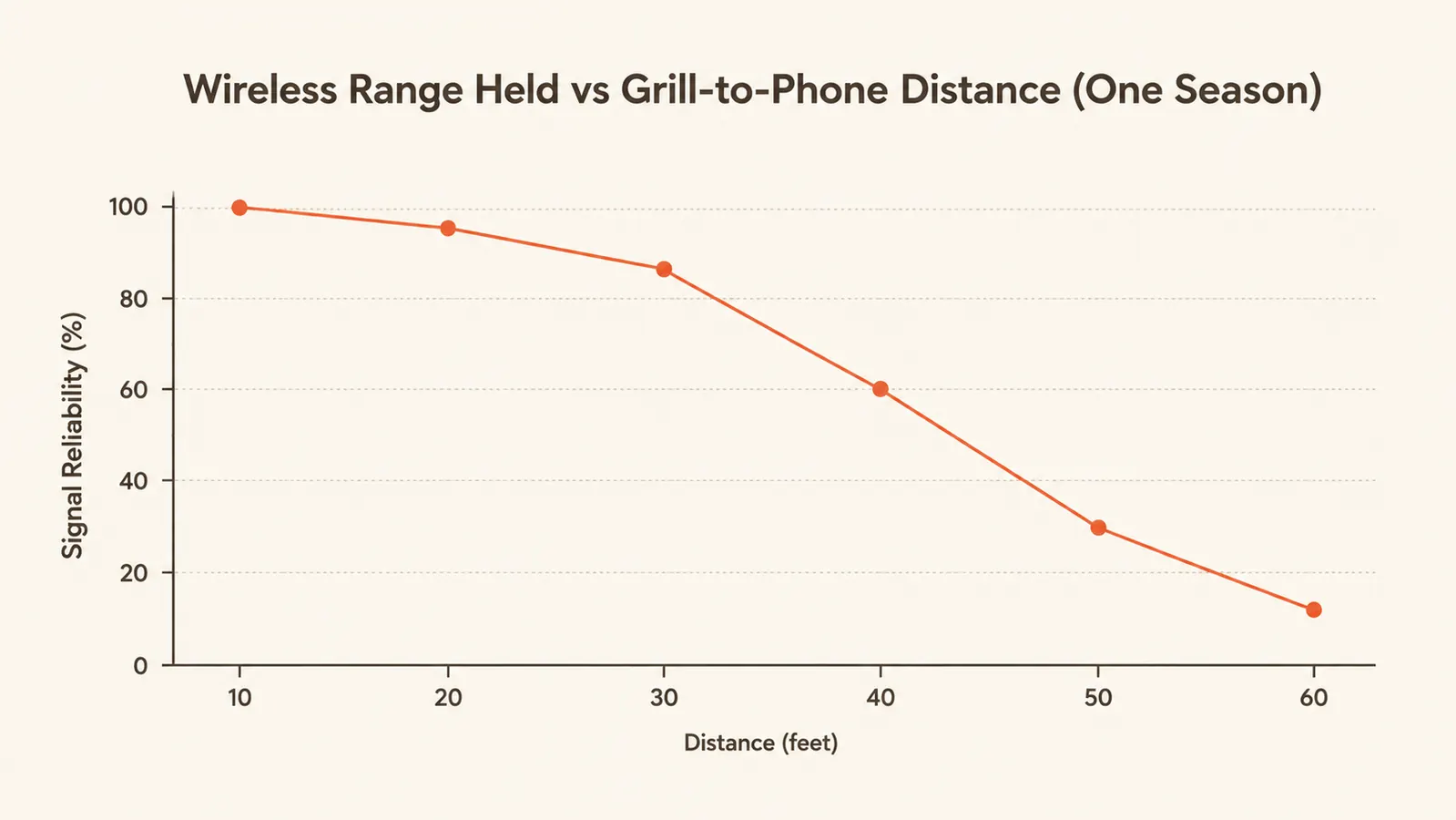
Wireless Range: Where It Actually Held Up and Where It Didn't
MEATER advertises up to 165 feet of Bluetooth range through the booster, and I'll tell you straight, I never got anywhere close to that in my own backyard. My patio isn't huge, maybe 40 feet from the Pit Boss to my back door, and even at that distance the connection dropped a handful of times over the season, usually when I walked from the kitchen into the living room where a couple of interior walls sit between me and the grill.
Inside about 25 to 30 feet with a mostly clear line of sight, the connection has been solid almost every time. That's plenty for checking the app from my kitchen table or the patio chairs where Diane and I sit most evenings. But if you're hoping to walk to the far end of the house or out to the garage and still get a live reading, temper your expectations. I lost the signal completely twice during the season, both times when I'd gone down to my basement to grab something during a long smoke.
The metal booster block that charges the probe is also what extends the range, and I learned the hard way that where you set it matters. Early on I had it sitting right next to the Pit Boss hopper, and the range was noticeably worse than once I moved it a few feet away on a side table, out of the direct path of the grill's own metal body. That's a small adjustment, but nobody tells you that in the box.
Accuracy on Steaks, Chicken, and Low-and-Slow Smokes
For quick cooks like steaks and chicken thighs, the MEATER Plus has been dead reliable. I've pulled ribeyes at 130 for medium-rare more times than I can count this season, and every single time the meat matched what the app told me within a degree or two when I double-checked with my old instant-read as a backup. That consistency is really the whole reason to own one of these things, and it delivered.
Low-and-slow smokes on the Pit Boss are where the ambient temperature sensor built into the probe comes into play, and that part took me longer to trust. The probe reads both internal meat temp and the ambient cooking temp at the same time, which sounds great on paper, but early in the season I noticed the ambient reading ran hotter than my Pit Boss's own built-in gauge by 15 to 20 degrees on a couple of cooks. I eventually figured out it was because I'd inserted the probe too close to the direct heat zone on the pellet grill, and once I started placing it further from the firebox side, the ambient reading lined up much closer to what my grill's gauge showed.
That Thanksgiving turkey was the real test of accuracy under pressure, with family coming over and no room for a mistake. I set the target at 165 in the thickest part of the breast, and the app's estimated time-remaining feature, which I'd been skeptical of all season, landed within about twenty minutes of when the bird actually hit temp. Eli thought that was the coolest part of the whole thing, watching the countdown tick down on my phone while everyone else was setting the table.
Battery Life and the Charging Block
The probe itself runs on a small internal battery that charges inside the booster block between cooks, and MEATER claims about 24 hours of cook time per charge. In practice, running it on shorter cooks, steaks and chicken mostly 20 to 40 minutes at a time, I've gone two to three weeks between charges most of the season. The long pork shoulder cooks ate into that faster, and after an eight-hour smoke I'd usually see the charge indicator down noticeably, though it never died on me mid-cook.
The booster block itself takes two AA batteries, and I swapped mine once over the whole season, right around the four-month mark. That's held up better than I expected given how often I've had the app open checking temps throughout a long smoke, which I assume draws more power from the booster than a quick weeknight steak does.
One thing I didn't expect was how the charging block itself became part of my routine rather than something I stashed in a drawer between cooks. I keep it plugged into a small outdoor-rated extension cord near the patio table now, so the probe is always topped off before I need it, the same way I keep my grill brush hanging on a hook instead of buried in the garage. Small habit, but it's the difference between a gadget that gets used and one that ends up in a junk drawer by August.
The App: Genuinely Useful, Occasionally Annoying
I'm not a phone person by nature, and I went into this expecting to hate the app. Most of the season proved me wrong. Setting a target temperature, picking the type of meat and the doneness level, and getting a straightforward push notification when it's time to pull the meat off the grill is about as simple as these things get. Diane figured it out on her own the first time she used it, no explanation from me needed, and that's about the highest compliment I can give a piece of software.
Where it's annoyed me is the occasional Bluetooth reconnect hiccup I mentioned earlier, and a handful of times the app has needed a full close-and-reopen to start reading again after a dropped connection. It's never cost me a ruined cook, since I've always caught it within a minute or two of checking my phone, but it's the kind of small friction that keeps this from being a flawless five-star experience. The recipe guides built into the app are a nice bonus, though I'll be honest, thirty years of grilling means I mostly ignore them and just set my own target temps.
The Probe Build and What I Considered Before Buying This One
The probe itself is a thin metal rod, thinner than I expected out of the box, and I was a little worried the first few times I pushed it into a thick pork shoulder that it might bend or snap under pressure. It hasn't. Forty-some cooks in, the probe still slides into meat clean and comes out clean, no bent tip, no discoloration along the shaft. I do wipe it down by hand rather than tossing it in the dishwasher, since MEATER is clear that it's not meant for that, and that extra step is about the only maintenance chore this thing has asked of me all season.
Before I bought the MEATER Plus, I'd been using a basic wired probe thermometer for a couple of years, the kind with a cord running from the meat, out the side of the lid, to a display sitting on the side shelf. It worked fine for keeping an eye on things while I stood right there at the grill, but it never let me actually leave, which defeated half the point on a long smoke. I also looked at a couple of the cheaper wireless options at the hardware store, but the reviews on those mentioned dead probes within a few months, and I wasn't interested in replacing a $20 gadget every season.
What ultimately sold me on the MEATER Plus over the wired option was exactly the freedom I mentioned with that first pork butt, being able to walk inside and watch a ballgame instead of standing at the grill for eight hours straight. At 61, with a bad knee that doesn't love standing on concrete all afternoon, that matters more to me now than it might have twenty years ago. The ambient sensor built into the same probe was the other selling point, since it meant I wasn't buying two separate gadgets, one for meat temp and one for grill temp, the way I'd have needed with some of the cheaper setups.
What We Liked
- Nailed steak and chicken doneness within a degree or two, all season long
- Freed me from opening the lid every few minutes on long pork shoulder smokes
- Ambient sensor tracked closely with my Pit Boss gauge once I learned proper probe placement
- App is simple enough that Diane figured it out with zero instructions
- Booster's AA batteries lasted roughly four months of regular use
- Countdown estimate on the Thanksgiving turkey landed within twenty minutes of actual
Where It Falls Short
- Real-world Bluetooth range fell well short of the advertised 165 feet
- Lost connection completely a couple times when I moved to another room or downstairs
- Ambient reading ran hot until I learned to place the probe away from direct heat
- Booster block position near metal grill parts noticeably weakens the signal
Eli thought the countdown ticking down on my phone was the coolest part of Thanksgiving. That's about as honest a review as a twelve-year-old is going to give you.
Who This Is For
If you do a lot of long, low-and-slow cooks, pork shoulders, briskets, whole turkeys, and you're tired of babysitting the grill every hour, this thermometer solves a real problem. It's also a smart buy if you've got grandkids or family around who like watching the process, since the app turns a slow smoke into something people can actually follow along with. Anyone who wants steak and chicken doneness dialed in without guesswork will get real value out of it too.
Who Should Skip It
If you rarely stray more than a few feet from the grill anyway, or you're the type who's happy with a reliable instant-read thermometer and a good internal clock, the wireless range and app setup probably aren't worth the extra cost for you. And if your patio layout has a lot of walls or metal between the grill and where you'll be sitting, temper your expectations on range before you buy, because that's the one place this thermometer didn't live up to the marketing.
A full season in, this is still the first thing I grab before I light the grill.
If you're done playing the lid-opening guessing game, the MEATER Plus lets you walk away and still know exactly when your meat is ready. Check the current listing for today's price and availability.
Amazon Check Today's Price on Amazon →